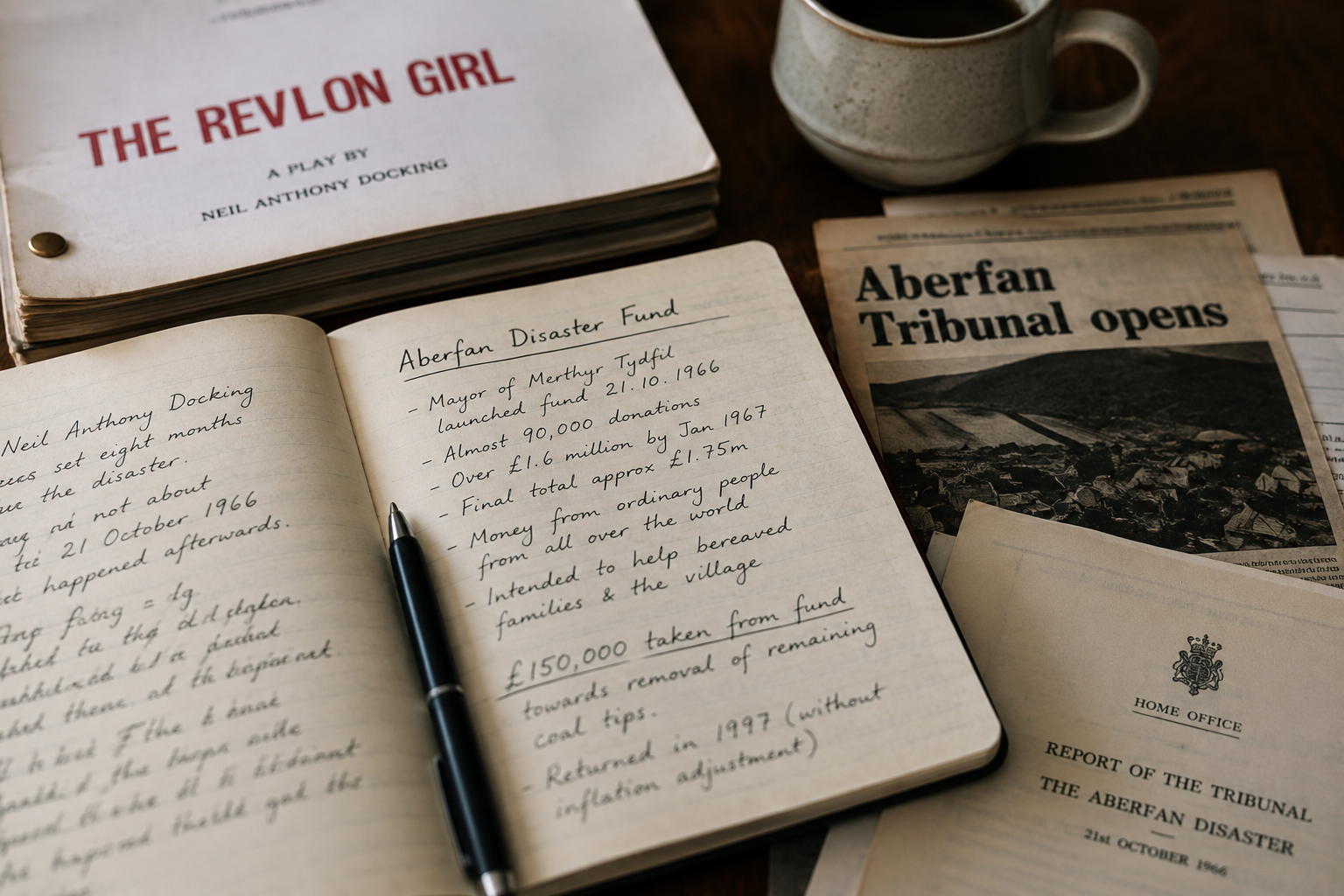
When we decided to stage The Revlon Girl, I knew about Aberfan. Or at least I thought I did.
Like most people, I knew what happened on 21 October 1966. I knew about the coal tip, Pantglas Junior School and the terrible loss of 116 children and 28 adults. But as I've started researching the history behind the play properly, I've realised how much I didn't know about what happened afterwards.
And some of it is difficult to comprehend.
The Revlon Girl is set eight months after the disaster, and that is important. Neil Anthony Docking doesn't recreate what happened that morning. His play is about the women who survived it and somehow had to carry on living when the world's attention had begun to move elsewhere.
The more I've researched that period, the more I've understood just how much there was for that community still to contend with.
An extraordinary public response
In the hours and days after the disaster, money began arriving in Aberfan from all over the world.
The Mayor of Merthyr Tydfil launched the Aberfan Disaster Fund on the day of the disaster and, by the time it closed to donations in January 1967, almost 90,000 contributions had been received.
More than £1.6 million had been donated, with the fund eventually reaching approximately £1.75 million.
These weren't government funds. This was money sent by ordinary people who had watched what happened in Aberfan and wanted to help the bereaved families and the village.
What happened to some of that money afterwards is one of the things I have found most shocking while researching this production.
The tips were still there
After the disaster, the remaining coal tips above Aberfan didn't simply disappear.
The Tribunal investigating the disaster was unequivocal about responsibility. Its first finding was: "Blame for the disaster rests upon the National Coal Board."
It also concluded that the disaster could and should have been prevented.
Understandably, the people of Aberfan wanted the remaining tips removed. Having just seen one of them destroy their school and part of their village, they didn't want to continue living beneath them.
But there was a dispute over who would pay.
The National Coal Board and the government would not meet the full cost of removing the tips without a contribution from the Aberfan Disaster Fund.
Eventually, £150,000 was taken from the fund towards the cost.
I had to read that more than once when I first came across it.
Money donated by members of the public to help a devastated community was used towards removing the remaining coal tips above that community, despite the official inquiry having placed responsibility for the disaster firmly with the National Coal Board.
For the people living beneath those tips, removing them wasn't an abstract question about landscaping a mountainside. It was about being able to feel safe in their own homes again.
Thirty years before the money came back
The controversy didn't disappear.
In 1978, the question of returning the £150,000 was raised in Parliament. The government response at the time was that there were no powers available to make a retrospective refund.
It wasn't until 1997, almost thirty years after the money had been taken, that the incoming Secretary of State for Wales, Ron Davies, announced that £150,000 would be returned.
His words are worth remembering. He said there should never have been a requirement for the Disaster Fund to contribute towards clearing the tips in the first place.
The original £150,000 was repaid, although without adjustment for the value that money had lost over those three decades.
What happened after the headlines?
This is the part of researching The Revlon Girl that I find myself increasingly drawn to.
We know the photographs. We know the terrible numbers. We know the name Aberfan.
But knowing about a disaster isn't necessarily the same as knowing what happened to the people who survived it.
The disaster itself happened in minutes. The aftermath lasted for years.
There were bereaved parents trying to rebuild lives that could never be the same, children growing up with what they had witnessed, a community living beneath the remaining tips and, at the same time, arguments taking place about money, responsibility and who should pay to make that community feel safe again.
It gives another layer to The Revlon Girl for me.
The women in Neil's play aren't historical figures frozen in the events of 21 October 1966. They're women trying to live eight months later. They talk, argue, laugh, get angry and try, however difficult it might be, to find a way of carrying on.
That's one of the things I loved about the play when I first read it, long before I knew as much about Aberfan as I do now.
And the more we research, the more there is to discover.
As we work towards opening The Revlon Girl on the 60th anniversary of the Aberfan disaster this October, I’ll continue sharing some of the things I’m discovering through the research. Some of this history is touched upon in the play, while other parts help us understand the wider world in which these women were living.
And, sixty years later, some of it still has the power to stop you in your tracks.