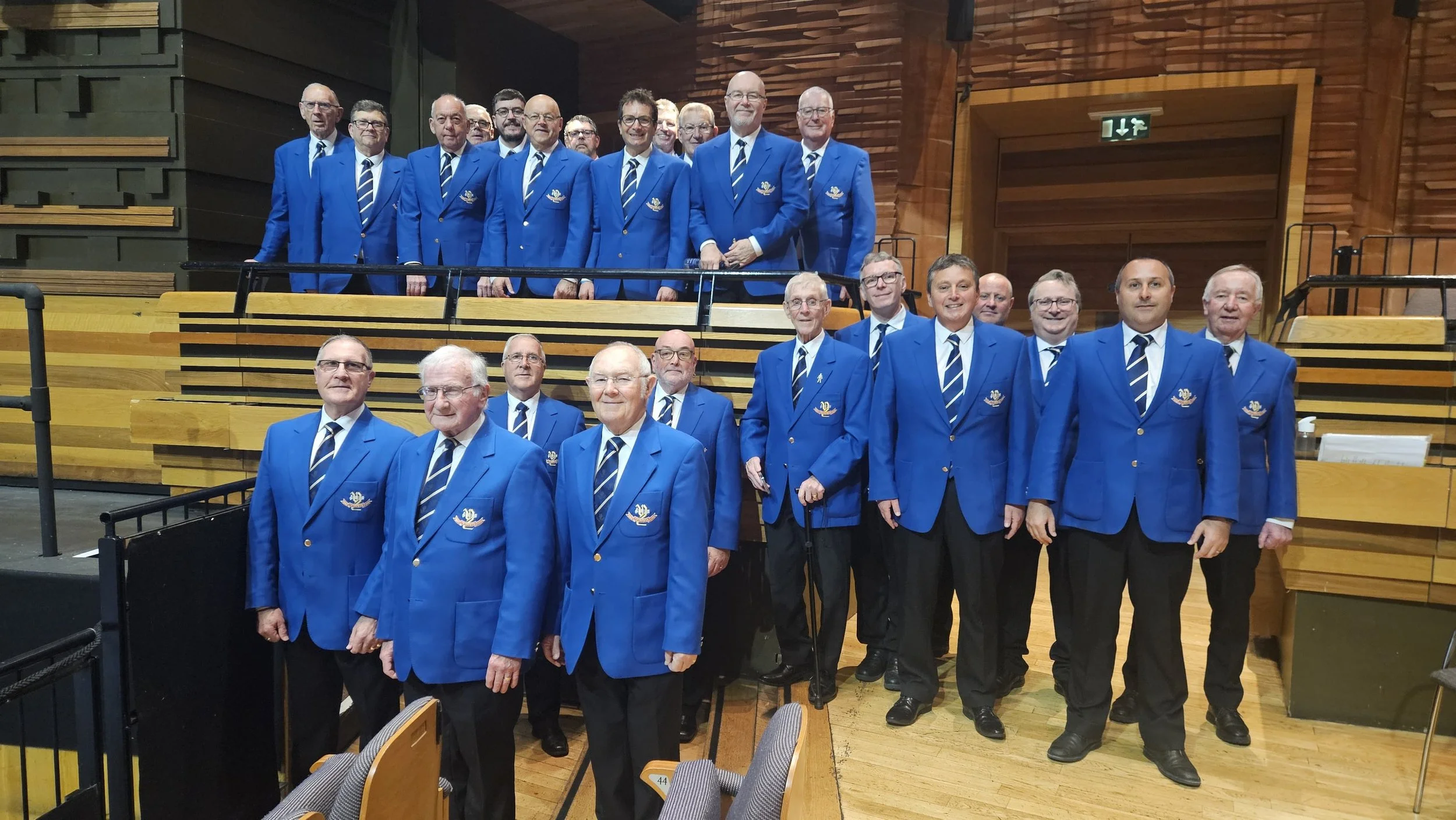
Ynysowen Male Choir
When you come to see our production of The Revlon Girl you will hear music by Ynysowen Male Choir. There is a reason we have chosen these particular voices: the choir grew out of the community of Aberfan in the years following the disaster.
As part of my research for the production, I have been reading an account of its beginnings by the late Cledwyn Davies, the choir’s first elected chairman. It tells a story of people finding a purpose together, and of a wish to give something back to those who had helped them.
From campaigning to singing
On 21 October 1966, a coal waste tip collapsed above Aberfan, killing 116 children and 28 adults. In the aftermath, help and sympathy arrived from across the world. But for the people living there, grief was accompanied by the fear of the remaining tips above their homes.
Local residents formed a tips removal committee to campaign for those tips to be cleared. I wrote about that struggle in our earlier blog, After Aberfan: The Fund That Was Meant to Help.
Davies recalls that, after the government agreed to their removal in July 1968, the committee’s work began to ease. Some of its male members started considering what else they could do for the community. The idea that emerged was a male voice choir.
It would give people something to work towards together. In time, it could also allow them to offer something in return to the communities beyond Aberfan that had shown such generosity.
In Davies’s account, Ynysowen Male Choir was formed in September 1968. Its name came from the telephone exchange serving the area, chosen to welcome men from the surrounding villages as well as Aberfan itself.
Eleven men at a village concert
The choir began with a handful of willing singers. After only a few rehearsals, eleven men performed at a village concert.
That is one of the details that stayed with me. We tend to encounter a choir once it is established, hearing the finished performance rather than thinking about the first few people who turned up to rehearse.
Numbers grew, and by the mid-1970s there were more than seventy choristers. Alongside them, wives and friends formed a supporters’ club, raising the money needed to help the choir become established. Its beginnings belonged to a much wider circle than the men on stage.
Looking back over its first thirty-eight years, Davies described performances across the UK and Europe for charitable causes. He also wrote of the choir’s contribution to the community’s recovery. The wish to bring people together, and to give something back, had become years of rehearsals, concerts and shared commitment.
The women who came together
The women of Aberfan were also creating a place of their own. In the months after the disaster, local mothers formed the Aberfan Young Wives’ Club. Some had lost children; others had not. What brought them together was friendship and a shared understanding of the community they lived in.
The club grew to sixty members, with a waiting list. They invited speakers, organised outings and made an annual trip to London to see a show. Their meetings offered room for interests, conversation and enjoyment alongside the grief that remained part of their lives. In his account for ITV Wales, journalist Jonathan Hill described women who did not need to speak about the disaster to understand one another.
It was a beauty demonstration arranged by the Young Wives’ Club that inspired The Revlon Girl. Neil Anthony Docking imagined that encounter through four bereaved mothers and the visiting Revlon representative, creating a play full of friction, tenderness and laughter.
The voices you will hear in The Revlon Girl
The Young Wives’ Club and Ynysowen Male Choir emerged in the period after the disaster, as people found ways to support one another and give shape to their lives again. The women created a regular meeting place and friendships that lasted for decades. The men built a choir whose shared purpose extended into charitable concerts beyond their own community.
Their stories also involved people working alongside them: wives and friends helped raise the money that established the choir. These were different groups within the same community, each sustained by people making time for one another.
That is what makes the choir’s music so meaningful to me in this production. On stage, we follow a meeting inspired by the women’s club. In the music, we hear a choir that grew from the same community’s efforts to find a way to live again.
The choir’s work continues. On 25 October 2026, Ynysowen Male Voice Choir is listed among the performers in Aberfan 60 at Wales Millennium Centre, a concert marking the sixtieth anniversary of the disaster.
As we prepare to open our own production on 21 October, that continuing connection matters. I wanted our audience to know something about the choir behind the music, and the people who first decided to sing together.
The Revlon Girl comes to Lewes from 21–23 October and Eastbourne from 28–31 October 2026. Find out more and book tickets.
With thanks to the late Cledwyn Davies, an original member and first elected chairman of Ynysowen Male Choir, whose written account informed this article.